valley.buddh.in
ghāṭī.
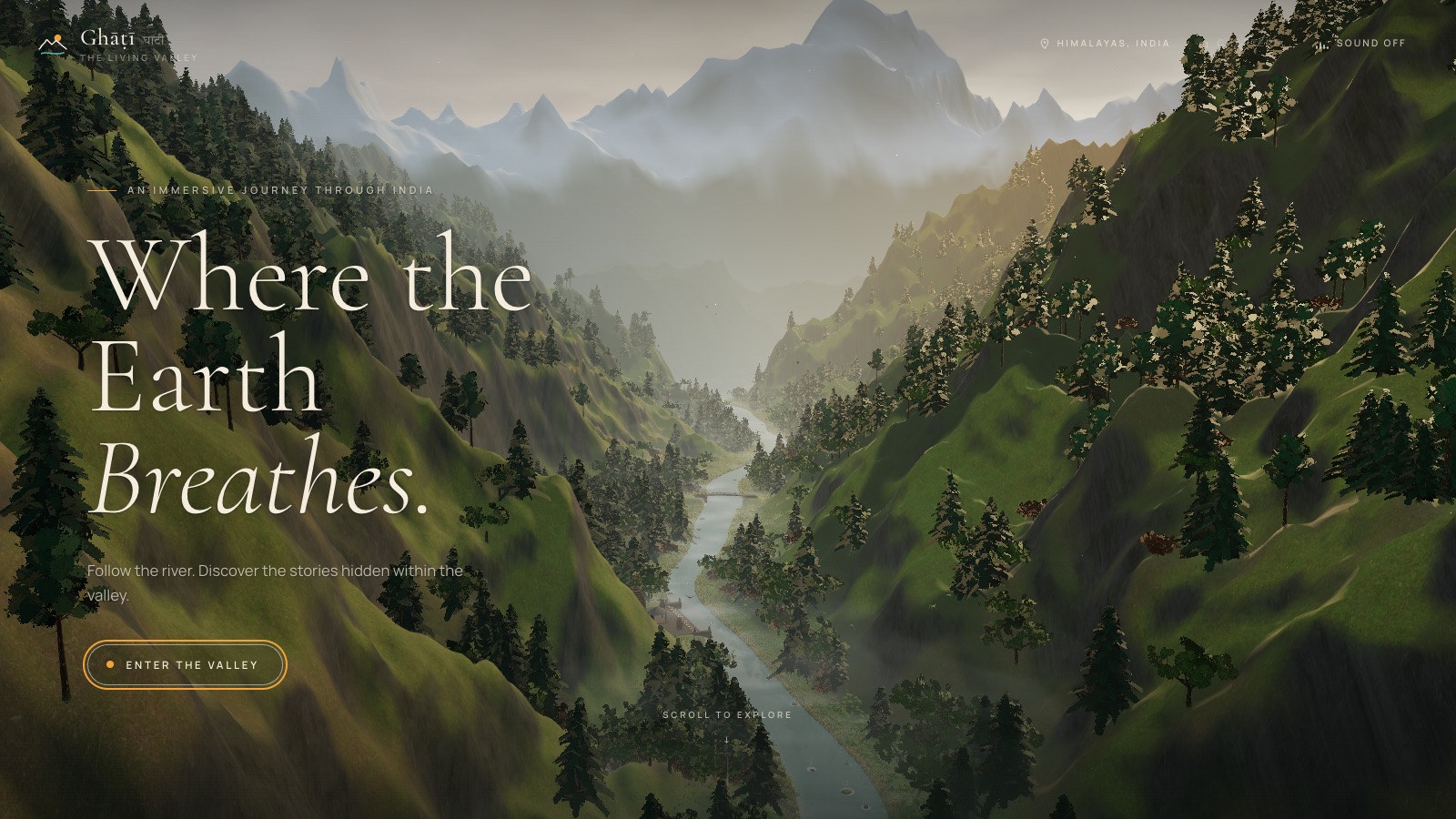
The Living Valley of India — an immersive, scroll-driven 3D journey down a Himalayan river valley in Uttarakhand. A camera rail carries you through five chapters: snow ranges at dawn, a glacier-fed river, a stone ghat with floating diyas, a deodar forest and a terraced hill village. Every tree, temple, wave and sound is generated in code.
5
Scroll Chapters
8
Discovery Hotspots
0
3D Models · Audio Files
~7k
Lines of TypeScript
2.8MB
Total Textures (CC0)
आगमन
·
नदी
·
घाट
·
वन
·
घाटी
·
आगमन
·
नदी
·
घाट
·
वन
·
घाटी
·
01
01 — Direction
Where the Earth breathes.
The brief was a place, not a product: make someone feel the hush of a Himalayan valley inside a browser tab. Instead of a free-roam game, the valley is told as a short film you scroll through — each chapter is a composed shot with a line of copy, and the camera only moves when you do.
Palette
Night forest, marigold, glacier
A deep forest-night base (#0b100e) and warm parchment ink, lit by marigold (#f2a33a) and saffron from the ghat lamps, with a glacial turquoise (#5cc2b2) pulled from the river itself.
Landscape-led colour
Type
Editorial serif + Devanagari
Cormorant Garamond italics carry the cinematic lines, Manrope handles the interface, and Tiro Devanagari Hindi sets each chapter's native name — आगमन, नदी, घाट, वन, घाटी — so the place speaks in its own script.
Cormorant · Manrope · Tiro
Motion
A camera on rails
Lenis-smoothed scroll drives a spline camera between five chapter compositions. Drag to look around — it springs back when you let go. Keys 1–5 jump chapters, M toggles sound.
Lenis + ScrollTrigger
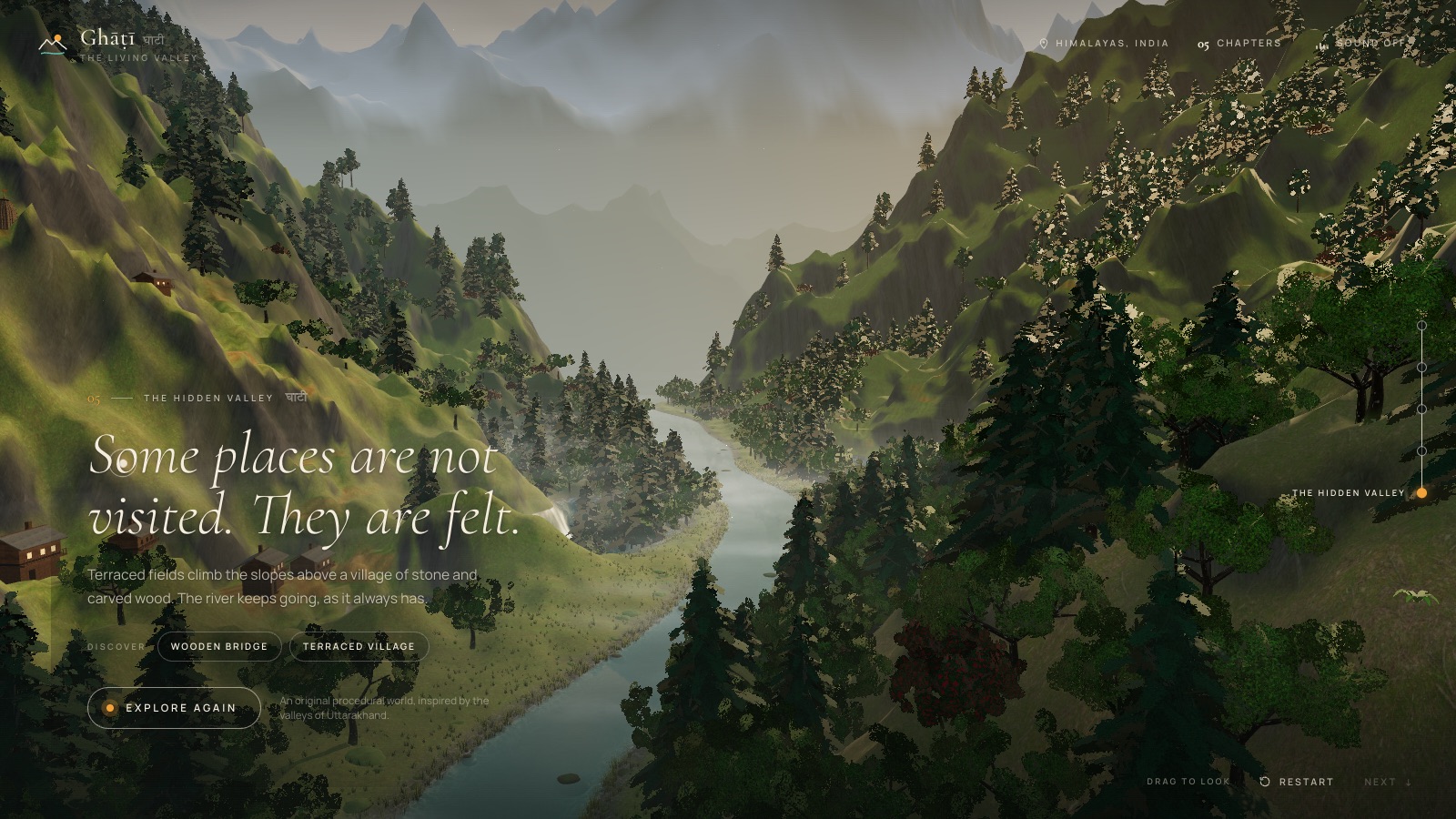
The world is original and procedural — not photogrammetry, and not a single downloaded model. Its content is specifically Himalayan: deodar, chir pine, banj oak and burans, a Nagara stone temple inspired by Jageshwar, a ghat with brass diyas, a timber footbridge and a Kumaoni village on the terraces.
02
02 — Technical Challenges
A whole valley, built in code.
No 3D models, no HDRIs, no audio files. Terrain, trees, architecture, water, sky, mountains, particles and sound are all generated at load time — which made performance and art direction the same problem.
01 — World Building
Procedural terrain and forests
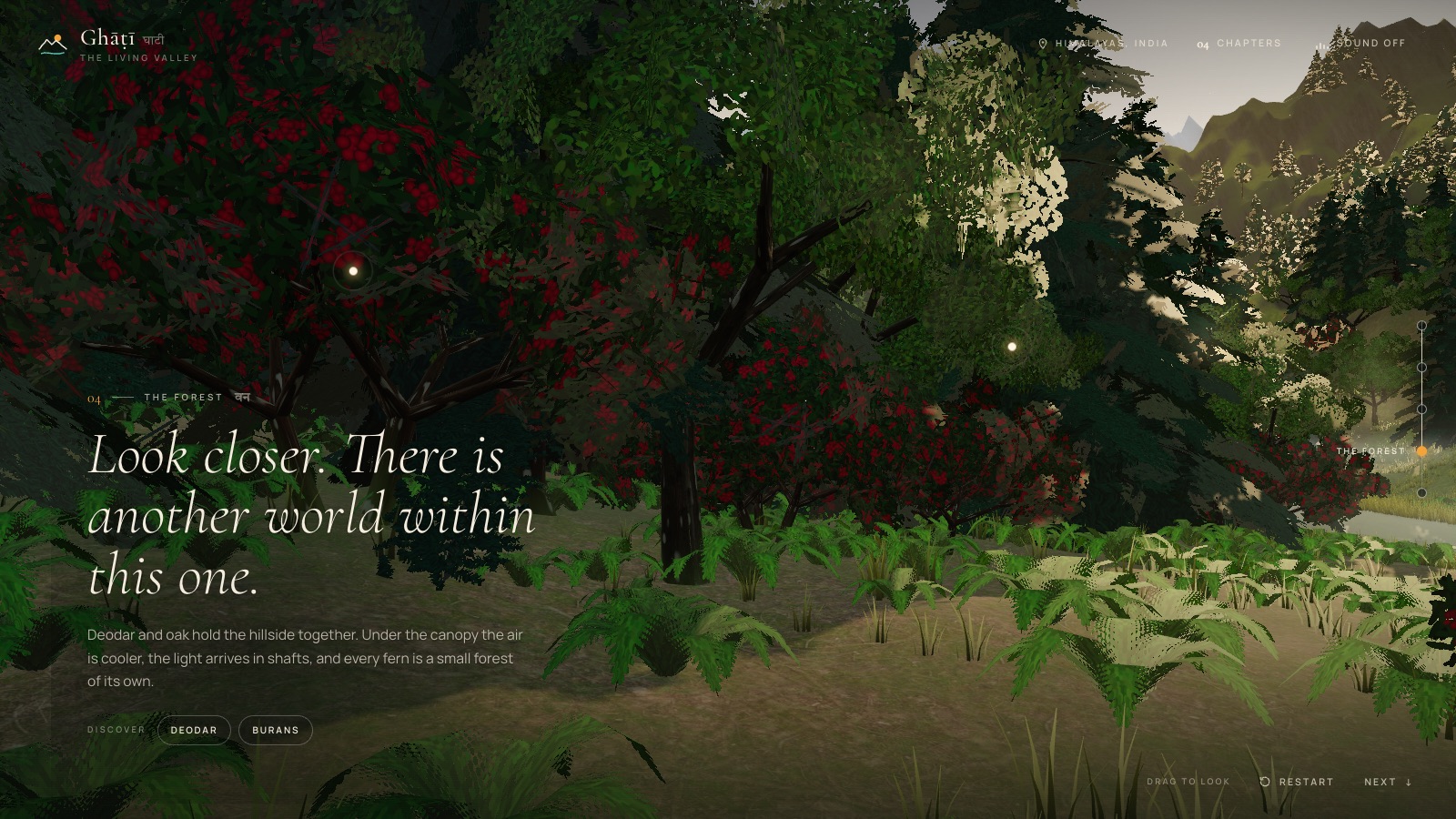
The valley is carved from layered noise around the river's path, then dressed with deterministic scatter — the same seed always grows the same forest. Trees are built as branching geometry with foliage cards painted onto a canvas atlas at load time, so deodars, pines, oaks and flowering burans each get their own silhouette without a single image download.
0 models
02 — Water
A river that reflects the valley
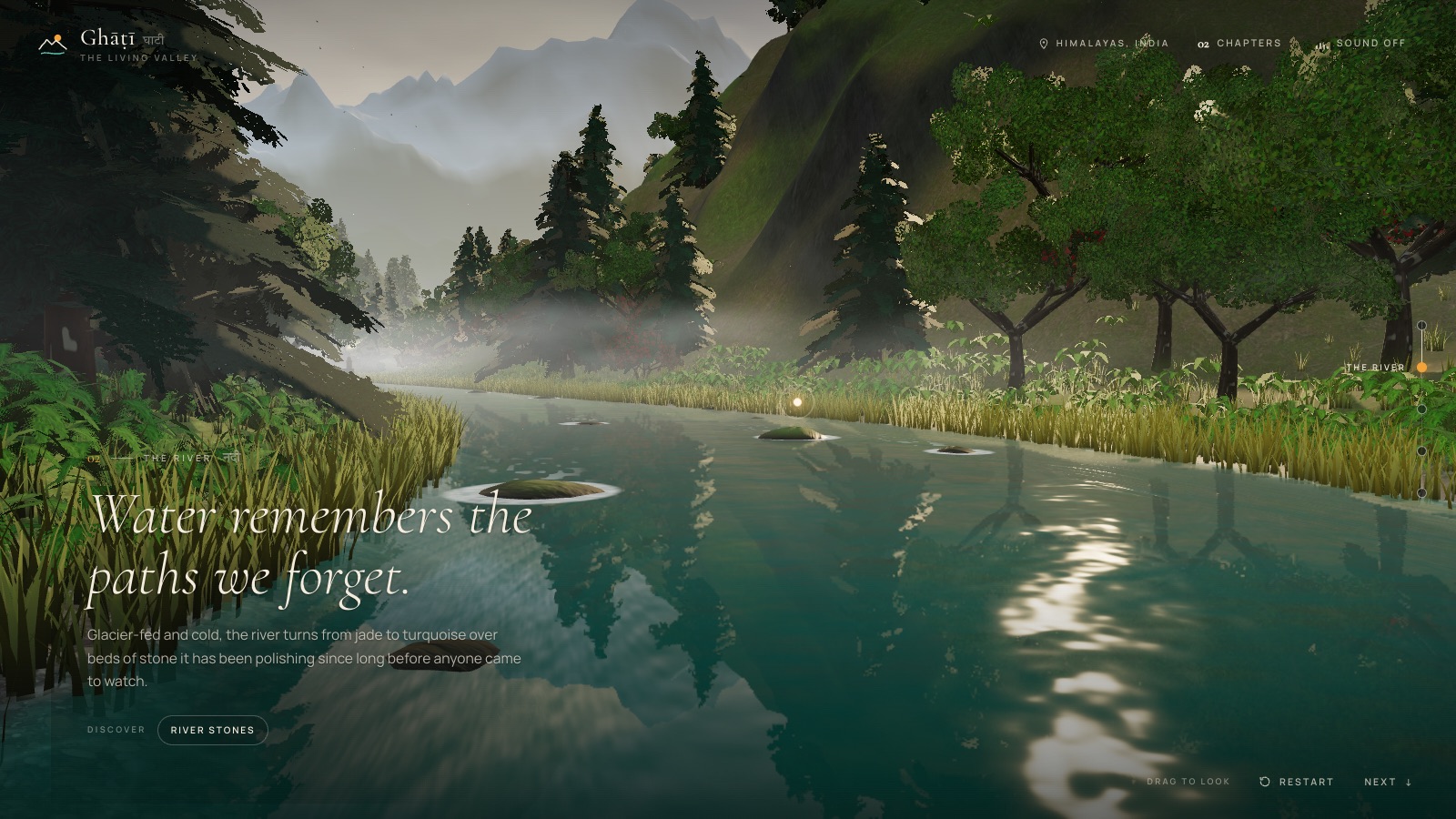
The river is a custom GLSL shader on top of a planar
Reflector: depth-based colour from jade to turquoise, flowing normals, foam around rocks, sun glints and fog-matched edges. Phones fall back to sky-only reflections so the shot still reads without the extra render pass.GLSL
03 — Atmosphere
Mist instead of post-processing
Rather than a heavy post-processing stack, a global patch to three.js's fog chunk adds height-based mist and sun scattering to every material at once. Subtle billboard light shafts, drifting petals, tone mapping, a vignette and film grain do the rest of the cinematic work.
1 patch
04 — Sound
A soundtrack synthesised live
The soundscape is procedural WebAudio: filtered noise for the river and wind, synthesised birdsong, a tanpura-like drone with a jawari shimmer, and a temple bell near the ghat. It starts muted and fades in only when the visitor asks for it.
0 files
05 — Performance
Adaptive on every device
Quality tiers decide shadows, reflection resolution and density up front, and a
PerformanceMonitor steps the pixel ratio down live when frames drop. An error boundary and WebGL context-loss handling swap in a static fallback instead of a blank screen, and a ridge-line loader with a rising sun covers the 5–10 seconds it takes to build the world.2 tiers
03
03 — Five Chapters
One river, five stories.
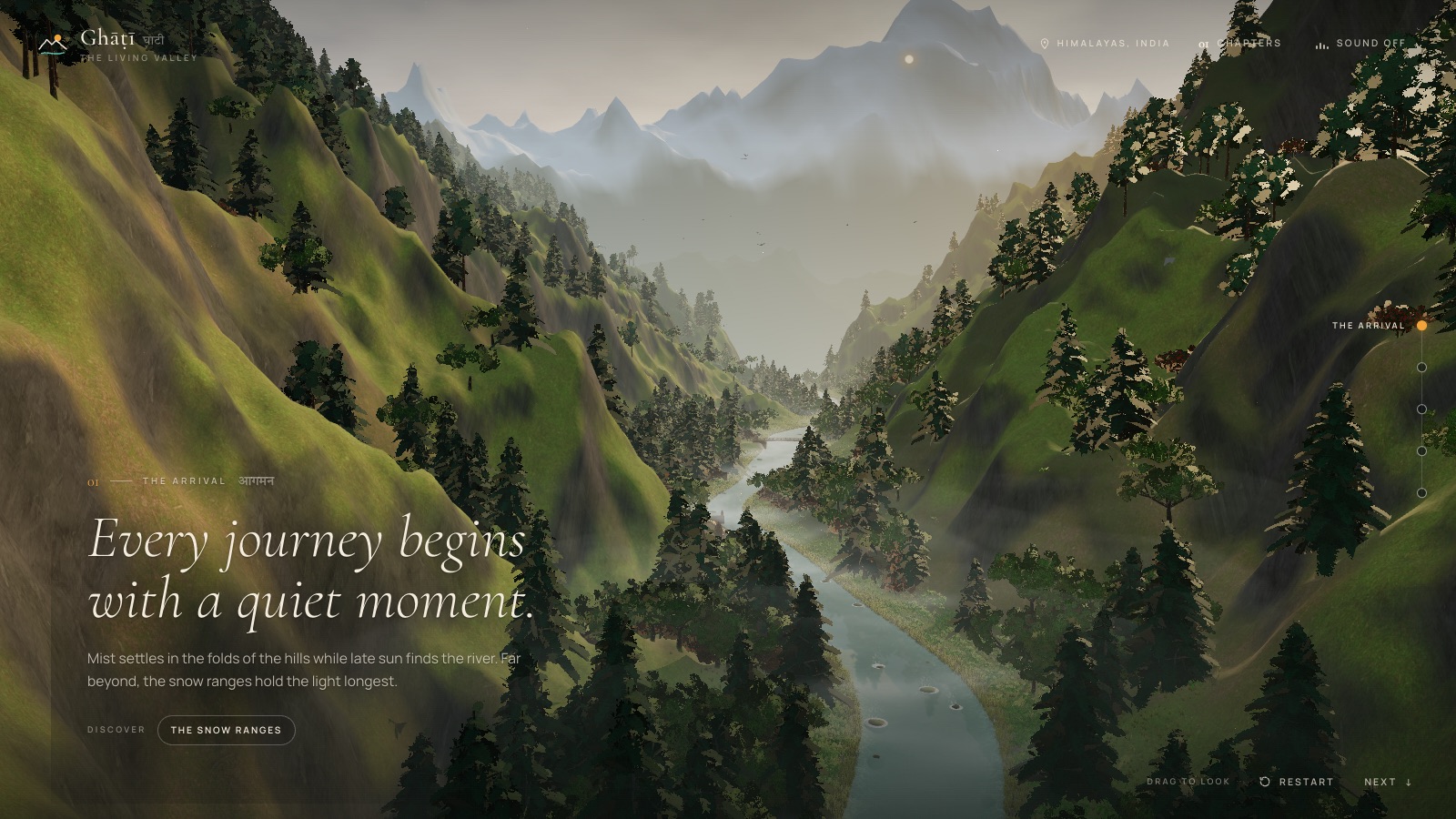
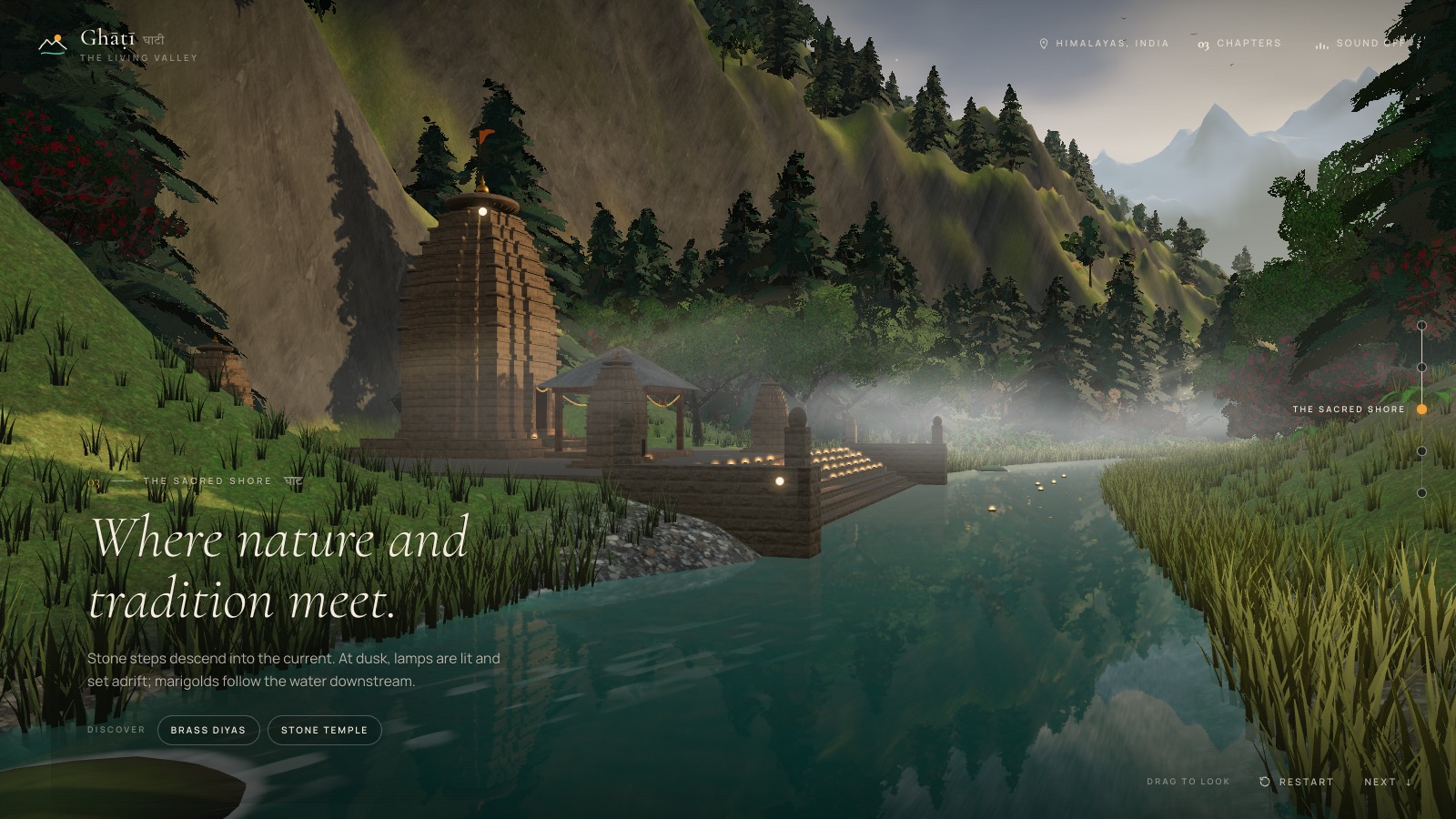
Each chapter is a composed shot with a line of copy and hotspots to discover — the snow ranges, river stones, brass diyas, the stone temple, deodar, burans, the wooden bridge and the terraced village — each opening a short panel of real cultural and natural history.
01
The Arrival · आगमन
Every journey begins with a quiet moment.
02
The River · नदी
Water remembers the paths we forget.
03
The Sacred Shore · घाट
Where nature and tradition meet.
04
The Forest · वन
Look closer. There is another world within this one.
05
The Hidden Valley · घाटी
Some places are not visited. They are felt.
04
04 — Result
A valley you can scroll.
A single-canvas Next.js experience with a minimal editorial interface on top: intro, chapter overlays, a progress rail, discovery panels and sound controls — all copy kept in one content file so the scene code stays free of prose.
5
Chapters on one spline camera — upper valley, riverbed, ghat, deodar grove, lower valley
8
Hotspots with short, factual panels on the landscape, ritual, architecture and ecology of Uttarakhand
CC0
Ten Poly Haven textures re-encoded as WebP; everything else, including foliage and sound, generated in code
100%
Custom-built — hand-written shaders, geometry, camera paths and audio graph throughout
05
05 — What I'd Improve Next
Further upstream.
Live
Enter the valley.
Best on a laptop or desktop with sound on. Scroll to follow the river, drag to look around, and tap the glowing points to discover the valley's stories.
Visit Ghāṭī View Sourcevalley.buddh.in


buddhpriya93@gmail.com · +91-8840-871-715 · buddh.in