From buddh.in, the personal portfolio of Buddhpriya Gautam
Indian product designer specializing in SaaS platforms, user experience, and AI-powered digital products.
| Buddhpriya Gautam | |
|---|---|
| Senior Product Designer | |

| |
| Gautam in a portfolio portrait | |
| Occupation | Product designer |
| Specialization | UX, SaaS, AI products |
| Current organization | RDash |
| Education | National Institute of Fashion Technology (B.Des) |
| Experience | 9+ years |
| Years active | 2016–present |
| Location | Gurugram, India |
| Notable work | RDash, RankWatch |
| Website | buddh.in |
Buddhpriya Gautam is an Indian product designer based in Gurugram, specializing in software-as-a-service platforms, user experience and AI-powered digital products. Gautam is a Senior Product Designer at RDash, a Y Combinator-backed construction management SaaS company,[1] and has more than nine years of experience in product design and digital experiences.
Trained in fashion design at the National Institute of Fashion Technology (NIFT) in Rae Bareli, Gautam completed design internships at Arvind Lifestyle Brands and Mahindra Retail before moving into digital product design in 2016. From 2016 to 2022, Gautam worked as a UI/UX designer at WebIQ Technologies on the RankWatch and WebSignals products, then joined RDash in 2022.[1]
Gautam's work covers SaaS platforms, mobile applications, AI-powered products, complex business workflows and scalable design systems. At RDash, Gautam has led design initiatives across procurement, billing, payments, reconciliation, analytics, onboarding and construction management workflows. According to the portfolio, Gautam contributed to product development as the company grew from $0 to $4.3 million in annual recurring revenue.[2][a]
Early life and education
Gautam studied fashion design at NIFT Rae Bareli from 2011 to 2015 and graduated with a Bachelor of Design (B.Des).[1] The coursework covered visual thinking, textiles and aesthetics, colour theory and the design process.
Gautam has described this training as the foundation for later product work. Fashion design taught visual communication, attention to how people behave and what they value, and a structured approach to problem-solving, from research and sketching through iteration to a finished piece. The same habits carried over into interface and workflow design, where the material changed from fabric to software.
As a student, Gautam took part in NIFT Converse in 2011 and 2012 and worked as a costume designer for the Ritambara fashion show at Antaragini, the cultural festival of IIT Kanpur, in 2013.[1]
Career
Gautam's career has moved from fashion retail through marketing technology to SaaS product design, with each stage adding more complex products and larger user bases.
Early career
In June and July 2015, Gautam completed two design internships. At Arvind Lifestyle Brands, the work covered fashion design and visual merchandising for the Flying Machine and F2000 menswear labels. At Mahindra Retail, Gautam designed Indian ethnic and maternity wear for the Mom & Me labels Kriti Fashion and Kriti Maternity.[1]
In June 2016, Gautam joined WebIQ Technologies as a UI/UX designer and led interface and experience design for the company's SaaS products, RankWatch and WebSignals. RankWatch is a search engine optimization platform for rank tracking, backlink analysis, site audits and competitor research. In this role, Gautam built dashboards and design systems for complex data visualization.[1][3]
Product design at RDash
Main article: RDash case study
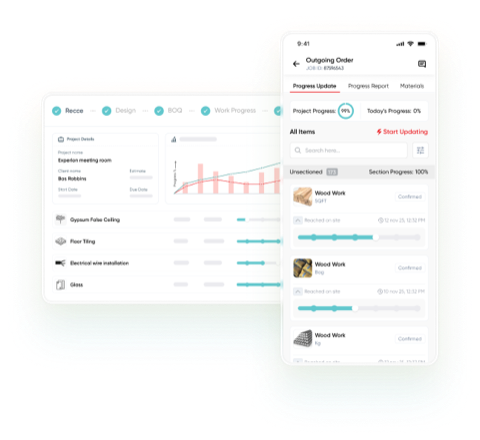
Gautam joined Vonken Brandtech in April 2022 as Senior Product Designer for RDash, a construction management platform used by developers, contractors and design studios.[1] Construction teams had been running critical work across spreadsheets for bills of quantities, messaging apps for approvals, separate finance systems and manual site reports. The result was little real-time visibility, slow decisions and cost leakage.[2]
Gautam's work at RDash has covered:
- Procurement: bills of quantities, vendor proposals, purchase orders and vendor-wise scope tracking.
- Billing and payments: milestone-based client billing, vendor invoices and payment records.
- Invoice automation and reconciliation: invoice capture and three-way matching against orders and goods receipts.
- AI-powered analytics: natural-language access to budgets, cash position and margins.
- Mobile-first site experiences: site surveys, progress updates and snag reporting for field engineers.
- Self-service onboarding: guided setup that helps smaller businesses go live without heavy implementation support.
For each of these, the main user problem was fragmentation: information lived in too many places and had to be re-entered by hand. Gautam's design approach was to keep each record in a single place and carry it through the whole workflow, so that a lead becomes a project, a proposal becomes an order, and an order becomes an invoice and then a payment, with no re-entry. The work was done in close collaboration with product managers, engineers and customer-facing teams.[2]
Selected projects
The following projects were produced at RDash. Descriptions are based on Gautam's portfolio, and all figures are self-reported.[a] Confidential product details are omitted.
Procurement and billing
Milestone-based billing
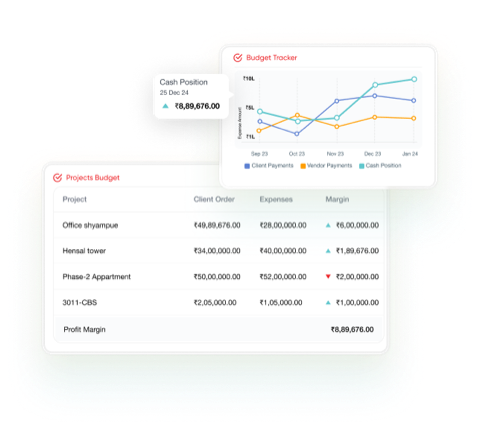
Overview. A billing workflow that ties client invoices to agreed project milestones rather than ad-hoc requests.
Problem. Contractors raised bills manually and chased payment over calls and messages, so it was hard to know when cash would come in.
Approach. Milestones and their billable value are set when the project is planned. When site progress marks a milestone complete, the system raises a billing trigger, prepares the invoice against the agreed amount and tracks it through approval and payment.
Key design considerations. Milestone status has to be clear to both contractor and client, partial completion has to be handled, and the link between site progress and the money owed has to stay visible.
Outcome. According to the portfolio, the workflow improved cash-flow predictability by about 20–30% and reduced manual follow-ups.[a] Read project details
Invoice booking and three-way matching
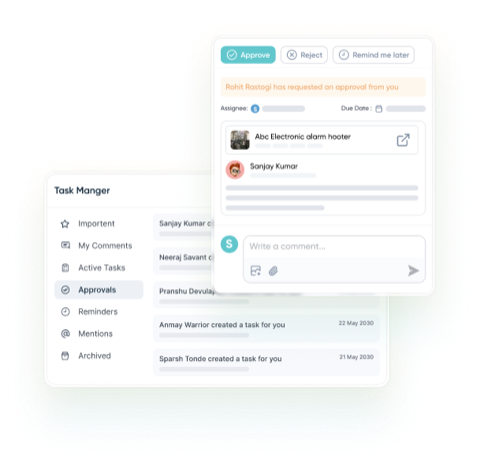
Overview. Automated invoice booking that checks each vendor invoice against its purchase order and goods receipt note before payment.
Problem. Finance teams typed invoice data in by hand and compared it with orders and deliveries line by line, which was slow and error-prone and led to vendor disputes.
Approach. Invoice data is extracted automatically, using optical character recognition, and matched against the purchase order and goods receipt note.[2] Matches go straight through. Mismatches in quantity, rate or tax are flagged for a person to review.
Key design considerations. The interface has to make mismatches easy to understand, let users override with a recorded reason, and keep a full audit trail.
Outcome. According to the portfolio, manual data entry fell by about 60–70%.[a] Read project details
AI-powered analytics
AI Analytics Copilot
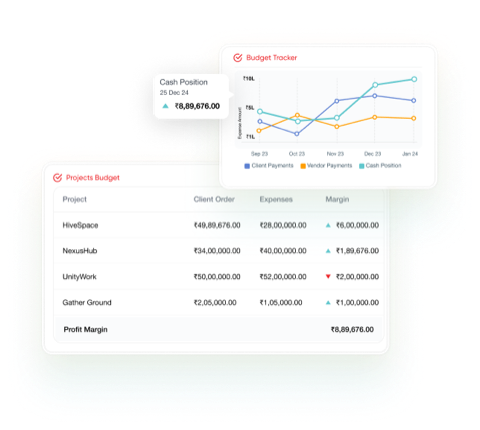
Overview. An AI assistant that lets users ask business questions in plain language and get answers from live project data.
Problem. Questions about budgets, margins and cash position depended on business intelligence reports and spreadsheet reconciliations, which took time and specialist effort.
Approach. Natural-language queries sit alongside the financial dashboards, so users can move between asking a question and checking the underlying chart or table.[2]
Key design considerations. Answers must show where their data comes from, so they can be checked and trusted. Users need suggested questions to get started, and the copilot must say clearly when it cannot answer.
Outcome. According to the portfolio, BI workload fell by about 55%.[2][a] Read project details
Mobile and voice experiences
Multilingual AI Voice Copilot
Overview. A voice interface in the RDash mobile app that lets on-site users find information and act on it by speaking.
Problem. Site engineers and supervisors often work with their hands full, in noisy places, and in languages other than English. Text-heavy screens slow them down.
Approach. Users ask in their own language about things like task status, material availability or pending approvals, and get spoken and on-screen answers with clear next steps.
Key design considerations. The design covers multilingual speech input, confirmation before any action that changes data, simple ways to recover from misheard requests, and screens that can be read at a glance in outdoor light.
Outcome. The portfolio does not report outcome metrics for this project.
AI-guided onboarding
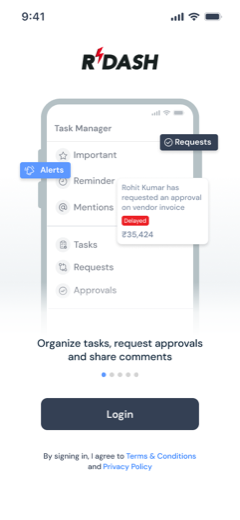
Overview. Guided, self-service onboarding and billing for small and medium-sized businesses.
Problem. Setting up the product had depended on hands-on implementation support, which made adoption slower and more expensive for smaller customers.
Approach. Step-by-step setup with contextual help guides new customers through configuring their organization, projects and teams, with self-service plan selection and billing.
Key design considerations. Show a useful result early, ask only for the information each step needs, and let users stop and come back without losing progress.
Outcome. According to the portfolio, implementation effort fell by about 50% and SMB customers could go live in seven days.[2][a] Read project details
Other portfolio work
See also: All case studies
Gautam's portfolio also includes:
- RankWatch: interface design for an SEO management platform.[3]
- Knovelo: a 0-to-1 mobile reader-community app.
- UNMC Timetable: a web portal for faculty timetable scheduling.
- Elite60: a 60-day fitness programme app, built solo as a PWA and Android app.
- Teasanti: a scroll-driven e-commerce experience for a tea brand.
- Ghāṭī: a scroll-driven 3D journey through a Himalayan river valley.
- Logofolio, Packaging and Hands On 3D: brand identity, packaging and 3D work.
Design philosophy
Gautam's approach to product design rests on the following principles:
- Start from real user problems. Work begins with how people actually do their jobs, such as a site engineer on a phone or an accountant reconciling invoices, not with a feature list.
- Simplify complex workflows. Enterprise processes are rarely simple, but they can be made clear. Gautam reduces steps, removes re-entry and shows only what each role needs.
- Balance business goals and user needs. Good design should improve measurable outcomes, such as faster billing or fewer disputes, while making work easier for the people doing it.
- Design scalable systems. Shared components and tokens keep a growing product consistent and help new designers and engineers get up to speed quickly.[2]
- Make AI useful and understandable. AI features should show where their answers come from, admit uncertainty and keep people in control of decisions.
- Measure outcomes. Design work is judged by its effect on the product and the business, not by how it looks alone.
- Collaborate closely. Design works best alongside product management and engineering, from discovery through delivery.
Skills and expertise
| Area | Skills |
|---|---|
| Strategy and research | Product strategy; UX research; information architecture |
| Interaction design | Interaction design; user flows; wireframing; prototyping |
| Systems | Design systems |
| Domains | SaaS product design; AI product experiences; mobile application design; data-heavy enterprise workflows |
Tools and technologies
Professional experience
| Period | Organization | Role | Notes |
|---|---|---|---|
| Apr 2022 – present | RDash (Vonken Brandtech Pvt. Ltd.) | Senior Product Designer | End-to-end product design for a construction management SaaS platform[1] |
| Jun 2016 – Apr 2022 | WebIQ Technologies Pvt. Ltd. | UI/UX Designer | UI/UX design for RankWatch and WebSignals[1] |
| Jun – Jul 2015 | Arvind Lifestyle Brands Ltd. | Design Intern | Flying Machine and F2000 menswear[1] |
| Jun – Jul 2015 | Mahindra Retail Pvt. Ltd. | Design Intern | Mom & Me ethnic and maternity wear[1] |
Education
| Years | Institution | Qualification |
|---|---|---|
| 2011–2015 | National Institute of Fashion Technology, Rae Bareli | Bachelor of Design (B.Des), Fashion Design[1] |
Portfolio and contact
- Portfolio: www.buddh.in (all case studies, portfolio PDF, résumé)
- Email: buddhpriya93@gmail.com
- LinkedIn: buddhpriya-gautam
- Behance: buddhpriyagautam
- Dribbble: Buddh
References and acknowledgments
Notes
- ^ Figures marked with this note are self-reported in Gautam's portfolio and are given as approximations. They have not been independently verified.
Sources
- ^ "About — Buddhpriya Gautam". buddh.in. Self-published.
- ^ "R'Dash — Buddhpriya Gautam" (case study). buddh.in. Self-published.
- ^ "RankWatch — Buddhpriya Gautam" (case study). buddh.in. Self-published.
External links
- Buddhpriya Gautam on LinkedIn
- Buddhpriya Gautam on Behance
- RDash, official website
This page's layout is inspired by encyclopedia biography articles. All text is original and written for this portfolio. Product screenshots are © RDash and are shown as portfolio work.